

RCM Hot Water
A flame burning above still water

Gas and Continuous Flow Hot Water Sunshine Coast

On the coast that mostly means a continuous flow unit running on LPG, with a smaller number of LPG storage tanks. Mains gas reaches few properties here. Flow rate and bottle supply decide what can actually be installed.

A continuous flow system heats water only while it is being drawn. Open a tap, the unit senses flow, fires, and heats the water on its way past. Close the tap and it stops. There is no tank, so there is no reservoir to empty and no stored water losing heat while nobody is home. A gas storage system does the opposite: it keeps a tank at temperature, ready to use, and reheats after it is drawn down.

Natural gas reaches very few Sunshine Coast properties, so the gas hot water we install and repair here runs on bottled LPG, and nearly all of it is continuous flow, with a small number of LPG storage tanks. That is why the two share a page. The first question on any gas job is still what the property has: bottles or a mains connection, and how much gas either can deliver.

Gas burns fuel, which produces emissions, and gas storage loses heat from the tank like any other tank. Both are stated plainly here because both are true. Neither is a reason to avoid gas; both are things you should know when comparing it against the alternatives.

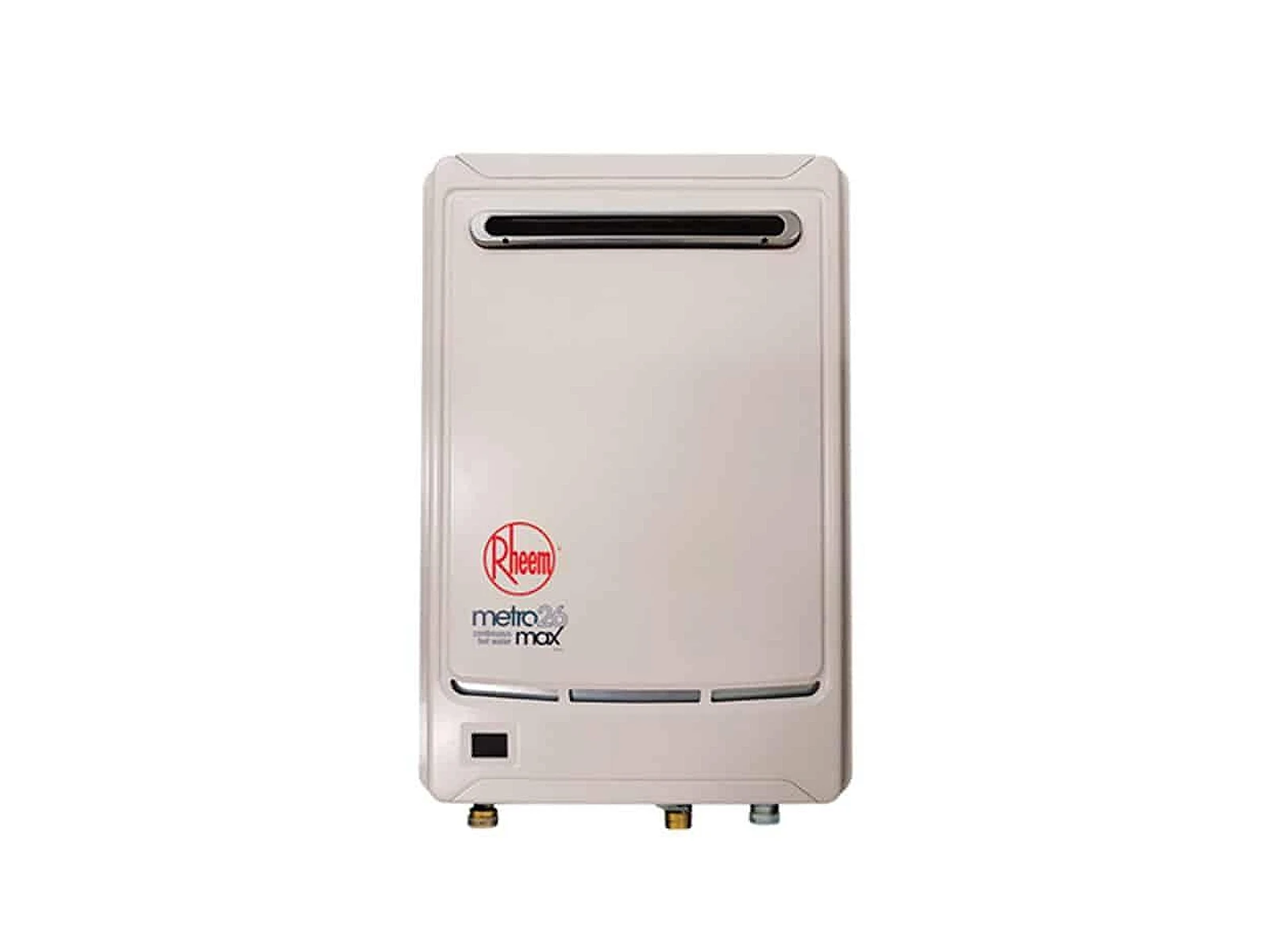
A Rheem Metro 26 continuous flow gas hot water unit, manufacturer product image

Flow rate: the number that actually matters

A continuous flow unit is rated by how many litres per minute it can raise by a given temperature. That rating assumes an incoming water temperature, and incoming water is cooler in winter, so the same unit delivers less on a cold morning than on a warm afternoon.

The practical sizing question is simultaneous outlets. One shower is straightforward. Two showers at once, or a shower plus the kitchen sink, is where an undersized unit shows itself.

The symptom is specific and worth recognising: not cold water, but the temperature sagging at one outlet when another opens. If that describes your existing system, it is undersized rather than broken.

Temperature controllers are worth asking about, particularly in a household with young children, since they let you set delivery temperature at the outlets rather than relying on mixing at the tap.

Minimum activation flow, and the wait for hot water

The unit needs a certain amount of water moving before it will fire. Below that threshold you get cold water, because the burner has not engaged. This catches people with very low-flow fixtures, or with a tap opened only slightly. It is a design characteristic rather than a fault, but it is the sort of thing that generates a service call because nobody mentioned it at installation.

Water sitting in the pipe between the unit and the tap is at room temperature. When you open the tap, that has to come through before the heated water arrives, so there is a delay proportional to the length of the run. On a compact house it is barely noticeable. On a long run to a distant bathroom it is genuinely annoying, and it is one reason unit placement is worth thinking about rather than defaulting to where the old system was.

You can also get a brief cold slug mid-use if the unit cycles off and on, typically when flow drops near the activation threshold.

LPG, and the rare mains connection

On the Sunshine Coast, gas almost always means LPG. It arrives in bottles, and that brings practicalities: cost per unit is generally higher than piped gas, you have to manage refills or exchanges, and running out mid-shower is a real event rather than a theoretical one. With heavy use a continuous flow unit can go through bottles quickly, which is worth pricing before committing.

Natural gas is piped and metered, and where it is connected it is generally the cheaper of the two per unit of energy and the more convenient, because it does not run out. Very few properties here have it, and running a new connection rarely pays for itself on hot water alone.

Appliances are configured for one or the other. A unit set up for natural gas will not simply run on LPG, and conversion is not always possible or economic.

Storage or continuous flow

Gas storage keeps a tank at temperature, ready to use, and reheats after it is drawn down. It delivers at full flow and will not falter when a second tap opens. It can run out, and it loses heat from the stored water between uses. On the coast it is the smaller share of the gas work, but it is still the right answer on some properties.

Continuous flow heats water only while it is being drawn. It does not run out and it has no standby loss, but it is limited by flow rate: how much water it can raise to temperature per minute. Open enough outlets at once and the temperature drops.

Neither is better in the abstract. The question is whether your household's constraint is total volume or simultaneous demand.

Supply capacity, ventilation and what the property can deliver

The most common surprise on a gas hot water job is that the existing supply cannot feed the new unit. A larger continuous flow appliance demands considerably more gas while running than a small storage heater, and the regulator, the line and, on mains, the meter were sized for what was there before.

Gas appliances also need ventilation and clearances, and those get compromised over the years by fences, decking, storage and plants appearing around what used to be open space.

Electric continuous flow exists, but it draws a substantial current for the heating it does, and the switchboard and supply have to carry it, which limits where it is practical.

All of this is assessed before quoting, because it changes the job substantially and nobody wants to discover it on installation day.

Common gas and continuous flow faults

Continuous flow units are controller-driven, so faults usually announce themselves as an error code. Those codes are manufacturer-specific and worth sending us before a visit: some indicate a reset, others a part. Ignition components, flow sensors and heat exchangers are the usual suspects, and scale can build up in the heat exchanger over time depending on water quality.

On storage units, pilot and ignition problems are usually a thermocouple or debris around the burner, and a gas control valve failure typically presents as a system that will not fire at all.

Because a continuous flow unit has no tank, a fault takes your hot water away immediately rather than after a reservoir empties, which is worth knowing when deciding how urgently to deal with an intermittent problem.

As with any gas appliance, if you can smell gas near it, leave it alone and call from somewhere else.

Where gas and continuous flow win, and where they do not

Continuous flow wins where space is tight, since there is no cylinder. It wins where demand is spread rather than concentrated, where nobody wants to think about running out, and where standby loss from a tank is an irritation. Against a heat pump, gas has a lower upfront cost in most cases and no positioning or noise constraint. Against solar, it is unaffected by roof orientation and weather, which is a genuine advantage on a shaded or poorly oriented property.

It is less convincing where several outlets genuinely run at once and the flow rate would have to be large, where bottle costs would mount with heavy use, or where the household would rather have a reservoir than a rate. And it burns fuel: a heat pump moving heat rather than generating it uses substantially less energy per unit of hot water.

Which of those trade-offs matters is a decision about your property and your priorities, and the comparison page lays them out side by side.

Licensed, qualified and local

Frequently asked questions

It will not run out of volume, which is the usual promise and it is true. What it can do is fall short on rate: it heats a certain amount of water per minute, and beyond that the temperature drops. So the failure mode is not a cold shower after twenty minutes, it is a cooler shower the moment someone opens the kitchen tap.

By flow rate rather than capacity. The question is how many outlets might run at once and what the unit can deliver at your desired temperature. Incoming water temperature matters too, since the unit is raising water from whatever it arrives at, and that is cooler in winter.

Continuous flow units need a minimum flow rate to activate the burner, as a safety and control measure. A tap opened barely, or a very low-flow fixture, can sit under that threshold and get cold water. It is a characteristic of the technology rather than a fault, though it surprises people.

No, and that is one of the main attractions: a wall-mounted unit and no cylinder taking up space or losing heat while you are at work. It also means there is no reservoir, so a fault takes your hot water away immediately rather than after the tank empties.

Natural gas is piped to the property and billed on usage. LPG comes in bottles that you refill or have exchanged. Appliances are configured for one or the other and are not interchangeable without conversion. Very few Sunshine Coast properties have mains gas, so nearly all gas hot water here runs on LPG, which changes the practicalities: you can run out, and the cost per unit of energy is generally higher.

Yes. Gas water heaters burn fuel and that combustion produces greenhouse emissions. Australian Government guidance is clear on this. Anyone telling you a gas system produces none is mistaken. Whether that matters to your decision is yours to weigh, but you should weigh it with accurate information.

Yes. Any tank keeping water hot around the clock loses heat to its surroundings, and gas storage is no exception. That standby loss is one of the arguments for continuous flow, which heats only while a tap is running. It is not a reason to avoid gas storage, but it is a real characteristic of it.

Not necessarily, and this catches people out. A larger continuous flow unit can demand more gas than the existing regulator and line were sized to deliver, and on a mains connection the meter matters too. It is exactly the sort of thing a site assessment establishes before the quote is agreed rather than on installation day.

Considering gas or continuous flow?

Tell us whether you have bottles or mains gas, and how many outlets might run at once. That is most of the sizing answer.

RCM works across Sunshine Coast and the hinterland. See the full Sunshine Coast service area for where we work regularly and where we travel on different terms.

RCM Hot Water on Google for the listing, opening hours and reviews.