
RCM Hot Water
A Rheem heat pump hot water system installed by RCM against a house wall, showing clearance and condensate drainage

Hot Water Installation Sunshine Coast

New builds, renovations, conversions and planned upgrades, sized to the household and to the connections the property actually has.

Installation covers six jobs that people tend to describe with one word. Putting a like-for-like unit back where the old one was, changing energy source, moving a system, increasing capacity, fitting out a new home, and adding to a renovation are all installations, and they differ enormously in what they involve and what they cost.

The quote follows from which one it is, and from what the property already has, which varies a great deal between Sunshine Coast suburbs. So the first conversation is about your connections and your space, not about brands.

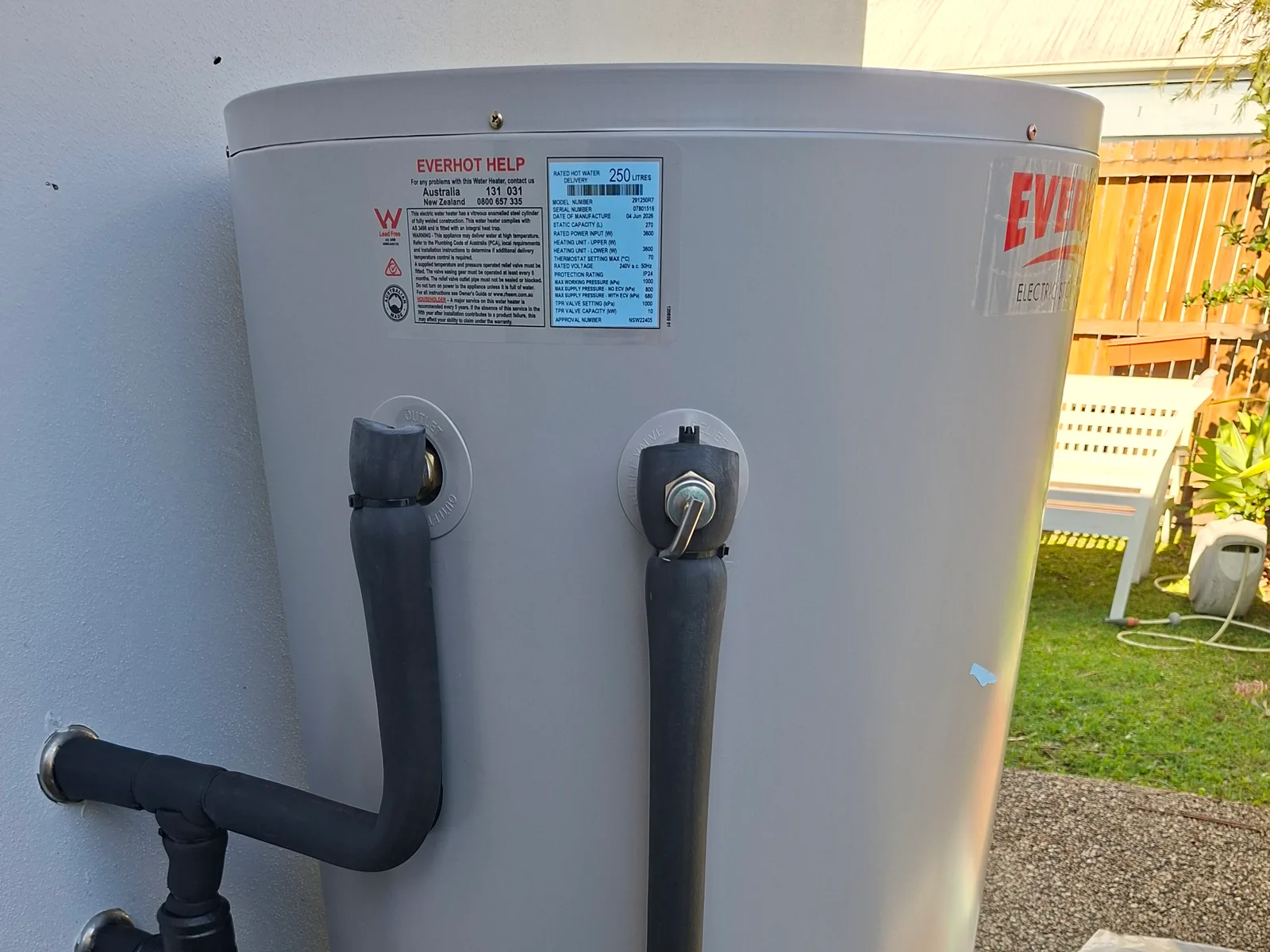
Relief valve and insulated flow and return connections on a storage tank installed by RCM

Which of these is your job

Like-for-like: same type, same place. The connections are there, so it is the fastest and cheapest.

Changing energy source: electric to heat pump, electric to gas, gas to solar. The biggest step, and the one that needs the most checking, because the new system needs services the old one did not.

Moving a system: new water lines, possibly new gas or electrical. Worth it when the old position made servicing awkward or put a noisy unit somewhere it should not be.

Increasing capacity: often triggered by a household that has grown or a bathroom that has been added. Sometimes a bigger tank, sometimes a different technology.

A new home: the one case where everything is open, and where the useful conversation happens before the walls close.

A renovation or extension: usually a capacity question plus an access question, because the demand changes and the system often has to move.

What a site assessment establishes

What is connected: electrical supply and switchboard capacity, gas supply and whether it is mains or bottled, and whether the line can carry a larger appliance.

Where a system can physically go, with the clearances it needs. For a heat pump that means real airflow and somewhere for condensate to drain. For solar it means roof orientation, pitch, shading and condition.

How the water gets from there to the outlets, since a long run to the bathrooms costs both water and waiting.

And access, for installation and for whoever services it in five years.

Sizing it to the household

Occupants, bathrooms, whether anyone takes baths, whether hot water gets drawn in two places at once, and whether any of that is about to change.

For storage the answer is capacity plus recovery rate. For continuous flow it is flow rate: the question is not how much it holds but how many outlets it can carry at once.

Bedroom count is a poor proxy for either. Two people in a four-bedroom house use two people's worth of hot water.

Positioning: the constraint people forget

Heat pumps have a fan and a compressor and draw heat from the air around them. They need clearance to work properly and they make noise, so under a bedroom window or boxed into a tight corner are both poor choices. They also produce condensate, which has to go somewhere sensible.

Gas appliances need ventilation and clearances of their own. Solar collectors need a roof that faces the right way, is not shaded through the day, and is in good enough condition to be worth mounting to.

Position is often what decides the system rather than price, and it is better to discover that before the quote than during the install.

Commissioning and handover

Installed is not finished. The system is filled, checked for leaks, brought up to temperature, and the relief and tempering valves are confirmed to behave as they should.

You should be shown where the isolation valve is, told what the system needs from you, and left with the manufacturer's documentation, since that is what governs the product warranty.

RCM covers workmanship for 12 months on systems it supplies and installs. Beyond that the unit is covered by its manufacturer's warranty, and those terms vary by brand and model, so the booklet supplied with your system is the one that governs.

Licensed, qualified and local

Frequently asked questions

What is included in an installation quote?

The unit, the installation itself, removal and disposal of any old system, valves and fittings, and any electrical, gas or plumbing work the new system needs. It should also cover commissioning and say what warranty applies. If a quote is much cheaper than the others, the difference is usually in what it leaves out.

Do you install systems supplied by someone else?

Ask us. It depends on the system and on where it came from, and it changes who carries the warranty on the unit if something is wrong with it out of the box. Worth a conversation before you buy rather than after it arrives on a pallet.

Can the new system go in a different place?

Often, and sometimes it is worth doing. Relocating means new water lines and possibly new electrical or gas work, so it adds to the job. It earns its keep when the current position makes servicing difficult, when a heat pump would otherwise sit under a bedroom window, or when moving it shortens the run to the bathrooms.

What do you need to know for a new build?

How many bathrooms and how many people the house is designed for, whether there is a bath or spa, what energy is connected or planned, and where there is space for the system. On a new build the useful conversation happens before the walls close, because that is when running services somewhere sensible is cheap.

Will my switchboard or gas line handle it?

That is exactly what a site assessment establishes. A larger continuous flow unit can need more gas than the existing line delivers, and a heat pump needs a suitable electrical supply. Finding this out before the quote is agreed is much better than finding it out on installation day.

How far ahead should I book?

For a planned installation, as far ahead as suits you. Call and ask what is realistic for your address. If it is a failed system rather than a planned job, say so, because that is a different conversation and belongs on the emergency page.

Planning an installation?

Tell us the property, the household and what is connected, and we will tell you the practical options.

RCM works across Sunshine Coast and the hinterland. See the full Sunshine Coast service area for where we work regularly and where we travel on different terms.

RCM Hot Water on Google for the listing, opening hours and reviews.