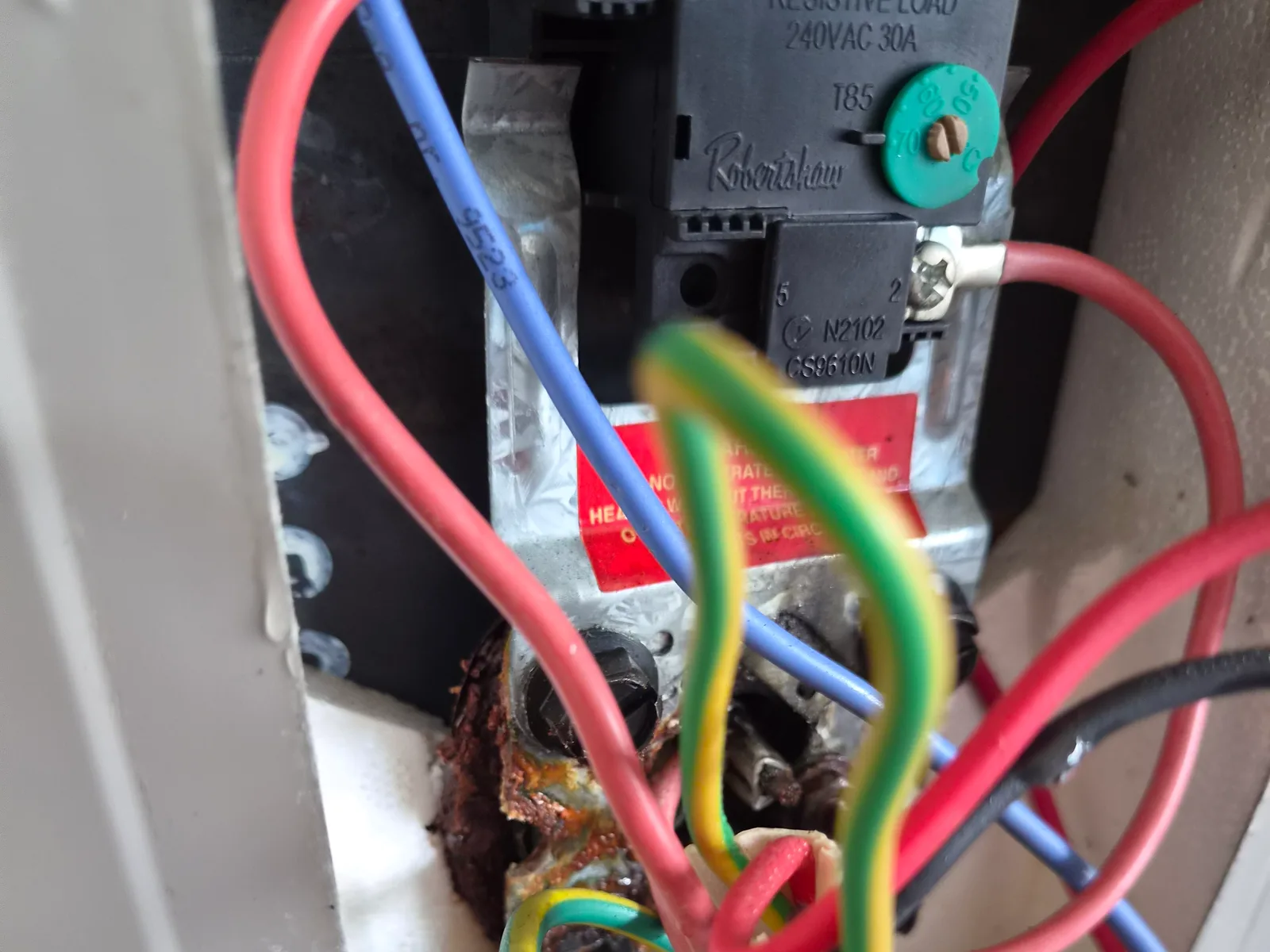
This is the question we get asked most, and it is worth saying up front that a hot water company writing this page has an obvious incentive to answer replace. So here is the honest version, including the situations where repairing is plainly the better decision.
Two things decide it more than anything else on any Sunshine Coast property: how old the system is, and whether the fault is a component or the tank itself. Almost everything else is a refinement on those two.
The decision, factor by factor
Factor
Points toward repair
Points toward replacement
Age of the system
Well within its expected life, with no history of trouble.
At or past the point most systems of its type get replaced.
Nature of the fault
A component: element, thermostat, valve, pump, controller, thermocouple.
The cylinder itself leaking or corroded. Not repairable at any age.
Repair history
First fault, or first in a long time.
Second or third repair in a short period. Components age together.
Parts availability
Parts current and readily obtainable.
Model no longer supported, or parts on long lead times.
Cost of the repair
Small relative to a replacement, on a system with life left.
Approaching a meaningful share of a new system's installed cost.
Whether it suits the household
Capacity and recovery still match how the hot water gets used.
Already running out, or the household has grown since it went in.
Running cost
Already an efficient system for the property.
Old electric storage where a heat pump would materially reduce running cost.
Warranty position
Still under manufacturer warranty for the failed part.
Out of warranty, with no support to fall back on.
Urgency
A repair restores hot water today with parts on the van.
Not urgent, so there is time to choose properly rather than take what is available.
Planned work on the property
No renovation or change planned.
Bathroom or extension coming, which changes demand and may move the system anyway.
How long a system usually lasts
Most storage systems get replaced somewhere around the seven to ten year mark. That is a pattern rather than a rule, and it varies with water quality, how hard the system works, and whether the sacrificial anode was ever replaced.
The anode is worth knowing about: it is a consumable rod inside the tank that corrodes so the tank does not. Replaced at the right time it can extend a tank's life considerably. Almost nobody does it, which is part of why the seven-to-ten pattern holds.
Some gas continuous flow units carry substantially longer warranties, which tells you what the manufacturer expects of them.
When repairing is clearly right
A system in its first several years with a failed element or thermostat. That is a routine repair, the tank is sound, and replacing it would be throwing away most of its life.
A solar system with a failed pump or controller. Those are components on a system whose expensive parts, the collectors and the tank, are usually fine.
A gas system with an ignition fault. Thermocouples and gas control valves are replaceable parts, not the end of the system.
And any fault at all on a system still within manufacturer warranty for that part, where the sensible first call is the warranty rather than a new unit.
When replacing is clearly right
A leaking cylinder, at any age. This is the one genuinely non-negotiable case. The tank is a pressure vessel with an internal lining, and once that fails the steel behind it corrodes from the inside out. It cannot be patched safely or legally.
A system that has needed several repairs in a short period, where you are funding an unavoidable replacement in instalments.
A system whose parts are no longer supported, where a repair depends on finding stock that may not exist next time.
And a system that no longer suits the household, where repairing it returns you to a system that was already too small.
The case nobody talks about: replacing early
There is a real argument for replacing a system that still works, once it is clearly near the end. A planned replacement is cheaper than an emergency one, it lets you pick the system that suits rather than whatever is on a truck today, and it avoids the day or two without hot water that a failure guarantees.
The argument against is simply that you are retiring something that still works. Which way that lands depends on how much disruption a failure would cause you and how close the system is.
It is a judgement rather than a rule, and anyone who tells you it is a rule is selling something.
Parts availability, which decides more than age does
A twelve year old system with parts still in production is often a better repair than an eight year old one where the controller was discontinued. Manufacturers support most models for a period after they stop selling them, and once that ends the choice narrows to salvaged parts, a generic substitute that may not be approved for the appliance, or replacement.
This matters most on the electronic side. Elements, thermostats, valves and anodes are largely common parts and stay available for a long time. Controllers, circuit boards, solar pump modules and heat-pump inverters are model-specific, and they are also the components most likely to fail on a system that is otherwise sound.
It is the single most useful thing the model number tells us, and the reason we ask for a photo of the data plate before quoting rather than after. Being told on the day that the part no longer exists is how a repair call turns into an unplanned replacement at the worst possible moment.
Where the warranty sits
Check the warranty before agreeing to anything, because it can invert the decision entirely. Storage cylinders often carry a longer warranty on the tank than on the components inside it, so a failed element on a system still under cylinder warranty is usually a straightforward repair, while a failed cylinder within that period may mean a replacement unit at little or no cost for the part.
Two conditions catch people out. Warranties generally require the system to have been installed by a licensed person and, on some models, to have been serviced to the manufacturer's schedule. Sacrificial anode replacement is the common one: on some storage warranties, skipping it voids the tank cover, which is a large sum resting on a part worth very little.
If you have the paperwork, or can find the model on the manufacturer's site, that is worth doing before the call. If you cannot, we can usually work out the position from the model number and the build date on the data plate.
What we would ask you
How old is it, as best you know. What is it doing, specifically. Has it been repaired before, and how recently. What brand and model, from the data plate. And whether it has been keeping up with the household or already falling short.
Those five answers usually settle it. Call 0415 611 356 or send a photo of the system and its plate.
Frequently asked questions
Is it worth repairing a ten year old system?
It depends on the fault. A ten year old tank with a failed element is a cheap repair, and if the cylinder is sound it can buy you real time. The same tank leaking from the cylinder is finished. Age alone does not decide it; age plus the nature of the fault plus how many times it has been repaired before usually does.
How many repairs is too many?
Once you are into the second or third repair on the same system in a short period, the pattern usually matters more than the individual fault. Components in a tank age together, so a system that has started failing tends to keep failing. At that point the money spent on repairs is better put toward a replacement.
My tank is leaking. Is that always a replacement?
If it is leaking from the cylinder itself, yes. The tank is a sealed pressure vessel with an internal lining, and once that lining fails the steel corrodes from the inside. It cannot be safely or legally patched. If the leak is at a valve or a fitting, that is a routine repair and the tank may be fine.
Should I replace before it fails?
There is a real argument for it once a system is clearly near the end. A planned replacement lets you choose the system that suits rather than whatever is available today, avoids out-of-hours costs, and avoids the day or two without hot water. Against that, you are retiring a system that still works. It is a judgement, not a rule.
Will you tell me honestly if a repair is better?
Yes, and it is worth asking any installer the same question directly. If the cylinder is sound and the fault is a component, we will say so. The situation where we will push replacement is where the tank itself has gone, because at that point a repair is not something we can responsibly offer.
RCM works across Sunshine Coast and the hinterland. See the full Sunshine Coast service area for where we work regularly and where we travel on different terms.